Jonkman Microblog
  • Login
Show Navigation
  • Public

    • Public
    • Network
    • Groups
    • Popular
    • People

Notices by Strypey (strypey@mastodon.nzoss.nz), page 97

  1. Strypey (strypey@mastodon.nzoss.nz)'s status on Tuesday, 15-Jan-2019 04:18:56 EST Strypey Strypey
    • Mark Shane Hayden
    • clacke: inhibited exhausted pixie dream boy 🇸🇪🇭🇰💙💛

    @clacke
    > If you can't even issue your debt in your own currency, you're just a normal business with an unusual business model.

    This is definitely true for local government in #NZ(city, district, and regional councils). If it's true for central governments, it has disturbing implications for human-scale government, and democracy in general.
    @msh

    In conversation Tuesday, 15-Jan-2019 04:18:56 EST from mastodon.nzoss.nz permalink
  2. Strypey (strypey@mastodon.nzoss.nz)'s status on Tuesday, 15-Jan-2019 04:17:11 EST Strypey Strypey
    • Mark Shane Hayden
    • clacke: inhibited exhausted pixie dream boy 🇸🇪🇭🇰💙💛

    @clacke these arguments are logical, but I suspect that logic is sound only within a framework of neo-classical assumptions (for example that capital can flow globally with no cross-border friction). I'm hoping we can scare up someone who knows much more about #MMT than I do, who can point out which of these assumptions are wrong, and how, and how MMT describes the international financial situation.
    @msh

    In conversation Tuesday, 15-Jan-2019 04:17:11 EST from mastodon.nzoss.nz permalink
  3. Strypey (strypey@mastodon.nzoss.nz)'s status on Tuesday, 15-Jan-2019 04:02:02 EST Strypey Strypey

    @noorul put it this way. GNOME 2.0 used to run fine on second-hand computers in the mid-2000s. These days I wouldn't even try to run GNOME 3.0 on a computer older than about 3 years.

    In conversation Tuesday, 15-Jan-2019 04:02:02 EST from mastodon.nzoss.nz permalink
  4. Strypey (strypey@mastodon.nzoss.nz)'s status on Tuesday, 15-Jan-2019 04:00:13 EST Strypey Strypey
    • z428

    @z428 well, there's basically two approaches. 1) assume that people are sheep, and try to work around their irresolvable ignorance, 2) take every opportunity to educate people about geek jargon, and the infostructure of the net. This includes doing one's best to use the correct terms for things, and being willing to explain them in whatever detail is requested. I sympathize with option 1), but I tend to go with option 2) ;-)

    In conversation Tuesday, 15-Jan-2019 04:00:13 EST from mastodon.nzoss.nz permalink
  5. Strypey (strypey@mastodon.nzoss.nz)'s status on Tuesday, 15-Jan-2019 02:16:35 EST Strypey Strypey
    in reply to
    • Adrian Cochrane
    • z428

    @z428 Apple has a massive marketing budget and supply chain, which they use to make sure iThings continue to be *perceived* as the go-to tool for hipster "creatives", regardless of their actual technical merits (or lack thereof), and that they are always in people's faces. This is what we're up against. The remaining technical problems can be easily solved if we can solve the perception and supply problems.
    @alcinnz

    In conversation Tuesday, 15-Jan-2019 02:16:35 EST from mastodon.nzoss.nz permalink
  6. Strypey (strypey@mastodon.nzoss.nz)'s status on Tuesday, 15-Jan-2019 02:12:42 EST Strypey Strypey
    • Adrian Cochrane
    • z428

    @z428 right, but you're not really describing *software* problems, so much as hardware/ software *configuration problems, which are a lot more complicated to fix. I suspect it's possible to build a device like what you describe with existing tech; generic tablet hardware from Shenzhen, #PureOS, and touchscreen versions of #GIMP, #Inkscape etc. But how would you get it into designers' hands?
    @alcinnz

    In conversation Tuesday, 15-Jan-2019 02:12:42 EST from mastodon.nzoss.nz permalink
  7. Strypey (strypey@mastodon.nzoss.nz)'s status on Tuesday, 15-Jan-2019 02:06:56 EST Strypey Strypey
    • Daniel Taylor
    • booklord 🇨🇦 🇬🇷 🇹🇼 🇭🇰
    • Neon Cipher

    @neoncipher OK. When did you run the test, and which version of each DE did you use?
    @RandomDamage @tootbrute

    In conversation Tuesday, 15-Jan-2019 02:06:56 EST from mastodon.nzoss.nz permalink
  8. Strypey (strypey@mastodon.nzoss.nz)'s status on Tuesday, 15-Jan-2019 02:05:16 EST Strypey Strypey
    • Neon Cipher

    @neoncipher definitely let me know when you do and flick me a link, I'd love to watch your videos on DE resource use. As you can tell, it's a subject I'm very curious about :)

    In conversation Tuesday, 15-Jan-2019 02:05:16 EST from mastodon.nzoss.nz permalink
  9. Strypey (strypey@mastodon.nzoss.nz)'s status on Tuesday, 15-Jan-2019 01:34:17 EST Strypey Strypey
    in reply to
    • Daniel Taylor
    • booklord 🇨🇦 🇬🇷 🇹🇼 🇭🇰
    • Neon Cipher

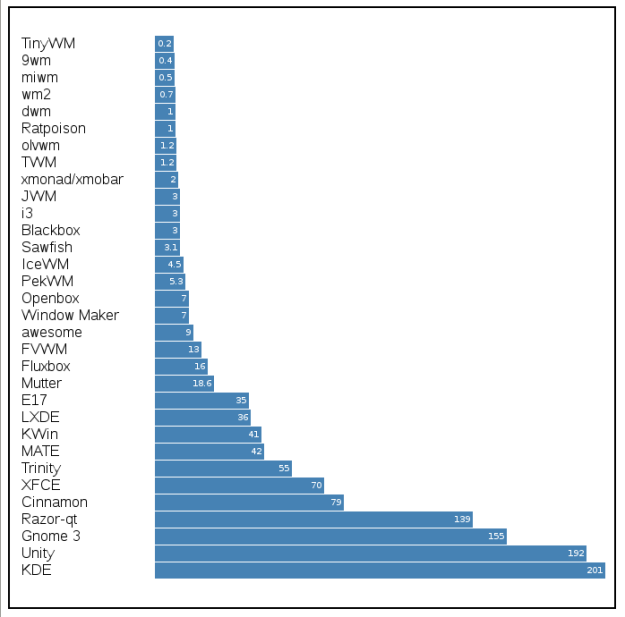
    @neoncipher but if you compare LXDE circa 2013 with Mate circa 2013, LXDE is very limited (I tested on Peppermint). It never hit the sweet spot for my purposes. If I can put up with a DE as limited as LXDE, I'll go all the way and use OpenBox. If I want a full-featured DE, I'll use Mate, for a similar resource cost. I haven't tried LXQT, but since Razor-qt used *heaps* more RAM than Mate, and more than XFCE, it didn't really qualify as a lightweight DE.
    @RandomDamage @tootbrute

    In conversation Tuesday, 15-Jan-2019 01:34:17 EST from mastodon.nzoss.nz permalink
  10. Strypey (strypey@mastodon.nzoss.nz)'s status on Tuesday, 15-Jan-2019 01:24:08 EST Strypey Strypey
    • Daniel Taylor
    • booklord 🇨🇦 🇬🇷 🇹🇼 🇭🇰
    • Neon Cipher

    @neoncipher Oops! You're right, my source did show LXDE using less RAM than Mate, but not by much. Although as I said in my blog piece, those figures were from 2013, and YMMV depending on exactly which version of each DE you test, which distro you're testing it on and which version, and so on.
    @RandomDamage @tootbrute

    In conversation Tuesday, 15-Jan-2019 01:24:08 EST from mastodon.nzoss.nz permalink
  11. Strypey (strypey@mastodon.nzoss.nz)'s status on Tuesday, 15-Jan-2019 01:20:21 EST Strypey Strypey
    • Daniel Taylor
    • booklord 🇨🇦 🇬🇷 🇹🇼 🇭🇰
    • Neon Cipher

    @neoncipher I can't watch videos on YT from China. Do you have your videos on a #PeerTube instances yet?
    @RandomDamage @tootbrute

    In conversation Tuesday, 15-Jan-2019 01:20:21 EST from mastodon.nzoss.nz permalink
  12. Strypey (strypey@mastodon.nzoss.nz)'s status on Tuesday, 15-Jan-2019 01:19:12 EST Strypey Strypey
    in reply to

    @noorul that graph was taken from this blog piece:
    https://l3net.wordpress.com/2013/03/17/a-memory-comparison-of-light-linux-desktops/

    In conversation Tuesday, 15-Jan-2019 01:19:12 EST from mastodon.nzoss.nz permalink

    Attachments

    1. Invalid filename.
      A Memory Comparison of Light Linux Desktops
      By netblue30 from l3net - a layer 3 networking blog

      After I install a new version of Linux, I usually take a good look at the screen. Does it have a task bar? Can I find my window after it was minimized? The direction some desktops are going is not clear. Making it easier for current users or for the people coming from Windows or Mac is not a goal anymore. User complains are dismissed, chalking it up to the fact that people don’t like change.

      Fortunately, in Linux we have plenty of other choices, and we do like change. We have no need to keep using desktops we don’t like.

      I will describe some of choices in this article, and I’ll attempt to measure the RAM memory requirements. I use free command in an xterm before and after the graphic environment is started on a separate X server (Xephyr). free command prints on the screen data made available by Linux kernel. The kernel knows at any moment how much memory is using and how many buffers are available.

      The tool I use to set it all up is virtenv. It configures a Xephyr xserver running OpenBox in a Linux kernel container (LXC). I shut down OpenBox and install the new window manager or desktop environment. I run the WM/DE as it comes up by default, without any kind of customization. The container works in a separate filesystem, and it will not overwrite the real filesystem on my computer. The computer is an older 64-bit machine, running Ubuntu 12.04.

      Joe’s Window Manager

      JWM is a light-weight window manager for the X11 Window System. A small memory footprint makes it a good choice for older computers and less powerful systems. Barry Kauler’s excellent Puppy Linux is based on JWM.

      You install it as sudo apt-get install jwm on Debian/Ubuntu, or as yum install jwm on Fedora. I takes about 3MB of memory to run.

      JWM window manager

      *box

      This is a series of three window managers. BlackBox is the original, Openbox and Fluxbox are forks.

      BlackBox is comparable to JWM, and loads in about 3MB of memory.

      Openbox is rarely used stand-alone, it is however the window manager of choice in a number of other desktop environments such as Gnome, KDE and LXDE. It runs in about 7MB of memory. CrunchBang is and example of distribution based on Openbox.

      Fluxbox is popular in many Live CDs such as Knoppix STD and GParted. It is currently the default window manager of PCFluxboxOS, Linux Mint Fluxbox CE and Salix OS Fluxbox. It runs in 16MB of memory.

      Install them on Debian/Ubuntu as sudo apt-get install blackbox openbox fluxbox, or yum install blackbox openbox fluxbox on Fedora.

      Fluxbox window manager

      Dynamic Window Managers

      A dynamic/tiling window manager adjusts the size and position of the windows so there is no overlapping and no space lost between them. This is in sharp contrast with the normal window managers which float and overlap windows. The distinction is not as strict today as it used to be, most modern tiling window managers can easily float windows. Some examples are dwm (1MB RAM), i3 (3MB) and awesome (9MB).

      Install them as sudo apt-get install awesome i3 dwm on Debian/Ubuntu, and as yum install awesome i3 dwm on Fedora.

      awesome Window Manager

      E17

      This is a beautiful desktop environment, the graphics just surpass everything else in this article. It is highly configurable and very fast. It runs in 35MB of memory in my tests.

      Install it as sudo apt-get install e17 on Debian/Ubuntu, or as yum install e17 on Fedora.

      E17 Desktop Environment

      LXDE

      The Lightweight X11 Desktop Environment was specially designed for computers with low hardware specifications, such as netbooks, mobile devices (e.g. MIDs) or older computers. In my opinion this is the DE that had the most to gain from Gnome 3 debacle. You can get today full major distros based on LXDE, such as Lubuntu and Fedora LXDE Spin. Usable and slim, LXDE runs on my computer in 36MB of memory.

      Install it on Debian/Ubuntu as sudo apt-get install lxde, or yum install lxde on Fedora.

      LXDE Desktop Environment

      Xfce

      Xfce is a desktop environment based on GTK+ 2 toolkit. It aims to be fast and lightweight, while still being visually appealing and easy to use. Xubuntu and Fedora Xfce Spin are two of the distros featuring Xfce.

      It runs in about 70MB of memory, which is a lot more than LXDE. Install it as sudo apt-get install xfce4 on Debian/Ubuntu, and yum groupinstall xfce on Fedora.

      XFCE Desktop Environment

      Conclusion

      People use computers in different ways for different tasks. Window Managers and light Desktop Environments are sometime the only choice for less powerful systems or for places where every bit of memory counts (gamers, programmers etc.). In part 2 and part 3 of this article I look at some other window and desktop managers, including KDE, Unity and Gnome 3.

      WM/DE Memory (MB)

      Links:

      TinyWM, 9wm, miwm, wm2, dwm, Ratpoison, TWM, xmonad, JWM, i3, Blackbox, Sawfish, IceWM, PekWM, Openbox, Window Maker, awesome, FVWM, Fluxbox, Mutter, E17, LXDE, KWin, MATE, Trinity, XFCE, Cinnamon, Razor-qt, Gnome 3, Unity, KDE

      Related Posts

      • A Memory Comparison of Light Linux Desktops – Part 2
      • A Memory Comparison of Light Linux Desktops – Part 3
      • Lightweight openSUSE: LXDE Desktop From Scratch
      • Lightweight Debian: LXDE Desktop From Scratch
  13. Strypey (strypey@mastodon.nzoss.nz)'s status on Tuesday, 15-Jan-2019 01:18:16 EST Strypey Strypey

    @noorul in 20123 only Unity and KDE used more RAM while idle than GNOME 3.0. According to the same graph, XFCE, used about twice as much RAM as Mate, and only slightly less than Cinammon.
    https://l3net.files.wordpress.com/2014/02/cmp-all4.png?w=625&h=617

    In conversation Tuesday, 15-Jan-2019 01:18:16 EST from mastodon.nzoss.nz permalink
  14. Strypey (strypey@mastodon.nzoss.nz)'s status on Tuesday, 15-Jan-2019 00:43:31 EST Strypey Strypey
    • Farhan Yusufzai

    @FarhanYusufzai no worries. Nice to meet you ;) Now that I'm confident you are discussing in good faith, I look forward to continuing a robust debate with you.

    In conversation Tuesday, 15-Jan-2019 00:43:31 EST from mastodon.nzoss.nz permalink
  15. Strypey (strypey@mastodon.nzoss.nz)'s status on Tuesday, 15-Jan-2019 00:40:54 EST Strypey Strypey
    • Farhan Yusufzai

    @FarhanYusufzai Playstation or MacOS are distributions of BSD. This is a separate issue. There is still a generic name for the family of OS, and that name gives credit to the project that lead the charge in making sure a libre version of AT&T UNIX could exist; BSD.

    In conversation Tuesday, 15-Jan-2019 00:40:54 EST from mastodon.nzoss.nz permalink
  16. Strypey (strypey@mastodon.nzoss.nz)'s status on Tuesday, 15-Jan-2019 00:38:12 EST Strypey Strypey
    • Farhan Yusufzai

    @FarhanYusufzai I think this argument fails to distinguish between the GNU *tools* and the GNU *Project*. It's the GNU Project that's referred to when we say "GNU/Linux". #GNOME is part of the GNU Project. The GNU #GPL is part of the GNU Project. The vision that inspired Linus to start working on his kernel was the GNU Project vision. That's why I say there would be no Linux without GNU.
    https://fossbytes.com/linus-torvaldss-famous-email-first-linux-announcement/

    In conversation Tuesday, 15-Jan-2019 00:38:12 EST from mastodon.nzoss.nz permalink

    Attachments

    1. Invalid filename.
      Linus Torvalds's Famous Email — The First Linux Announcement
      By Adarsh Verma from Fossbytes
      Linus Torvalds’s Famous Email — The First Linux Announcement
  17. Strypey (strypey@mastodon.nzoss.nz)'s status on Tuesday, 15-Jan-2019 00:15:52 EST Strypey Strypey
    • Farhan Yusufzai

    @FarhanYusufzai good to know :) To balance things up, let me offer some unsolicited advice. First impressions count, *especially* online. When you interact with someone for the first time, it's more effective to use a more conciliatory tone, and show that you are making an effort to see things from their point of view.

    In conversation Tuesday, 15-Jan-2019 00:15:52 EST from mastodon.nzoss.nz permalink
  18. Strypey (strypey@mastodon.nzoss.nz)'s status on Tuesday, 15-Jan-2019 00:14:20 EST Strypey Strypey

    Māori make up about 15% of the population in #Aotearoa (#NZ). According to this podcast, 1% of small businesses in Aotearoa are owned by Māori people:
    http://seeds.libsyn.com/maori-perspectives-on-social-enterprise-with-kaye-maree-dunn-cain-kerehoma-and-chanelle-armstrong

    In conversation Tuesday, 15-Jan-2019 00:14:20 EST from mastodon.nzoss.nz permalink

    Attachments

    1. Invalid filename.
      Seeds: Māori perspectives on Social Enterprise with Kaye Maree Dunn, Cain Kerehoma and Chanelle Armstrong
      "What does Social Enterprise mean to us as Tangata Whenua?"  This question was explored during this participative session 2 at the Aotearoa Social Enterprise Forum held on 19 October 2018.   We heard from Kaye Maree Dunn (Chair) along with Cain Kerehoma, and Chanelle Armstrong.  Their bios are below. The point when each speaker spoke during the session: 3:02 - Kay Maree Dunn introduction and overview of key points 18:25 - Chanelle Armstrong on Stay Native https://www.staynative.co.nzand https://www.facebook.com/staynativenz/ 36:34 - Cain Kerehoma speaking on Social Enterprise Tairāwhiti 1:03:38 - Conclusion by Kay Maree Dunn This is the article on Maoritanga mentioned in the introduction https://thespinoff.co.nz/business/21-08-2018/what-social-enterprises-in-aotearoa-can-learn-from-maoritanga/   If you'd like a copy of the book "Social Enterprises in New Zealand: A Legal Handbook" then send me an email stevenmoe@parryfield.com   Kaye Maree Dunn, Special Projects Manager, Managing Director Māori Womens Development Inc, https://mwdi.co.nz Making Everything Achievable, Indigital Blockchain Limited.    Cain Kerehoma, Social Enterprise Tairāwhiti   Chanelle Armstrong from Stay Native
  19. Strypey (strypey@mastodon.nzoss.nz)'s status on Monday, 14-Jan-2019 23:58:54 EST Strypey Strypey
    • Neon Cipher

    @neoncipher I don't expect to need a lightweight DE, especially if I upgrade the hard drive to an SSD. If my 32-bit netbook can run Mate fine with 2GB RAM, I expect a lot more from a MacBook the same age.

    In conversation Monday, 14-Jan-2019 23:58:54 EST from mastodon.nzoss.nz permalink
  20. Strypey (strypey@mastodon.nzoss.nz)'s status on Monday, 14-Jan-2019 23:57:08 EST Strypey Strypey
    • Daniel Taylor
    • booklord 🇨🇦 🇬🇷 🇹🇼 🇭🇰

    @RandomDamage according to the research I've looked at, Mate uses less resources than #LXDE, which isn't being developed since it merged with #RazorQT to create #LXQT. It uses *much* less than #XFCE, which has a reputation as a light DE, but I think that stopped being true a long time ago (unless you're comparing it to bloatware like #Unity, #KDE or #GNOME).
    https://www.coactivate.org/projects/disintermedia/blog/2018/04/16/choosing-which-desktop-environment-to-use-with-gnu-linux/
    @tootbrute

    In conversation Monday, 14-Jan-2019 23:57:08 EST from mastodon.nzoss.nz permalink
  • After
  • Before
  • Help
  • About
  • FAQ
  • TOS
  • Privacy
  • Source
  • Version
  • Contact

Jonkman Microblog is a social network, courtesy of SOBAC Microcomputer Services. It runs on GNU social, version 1.2.0-beta5, available under the GNU Affero General Public License.

Creative Commons Attribution 3.0 All Jonkman Microblog content and data are available under the Creative Commons Attribution 3.0 license.
Switch to desktop site layout.